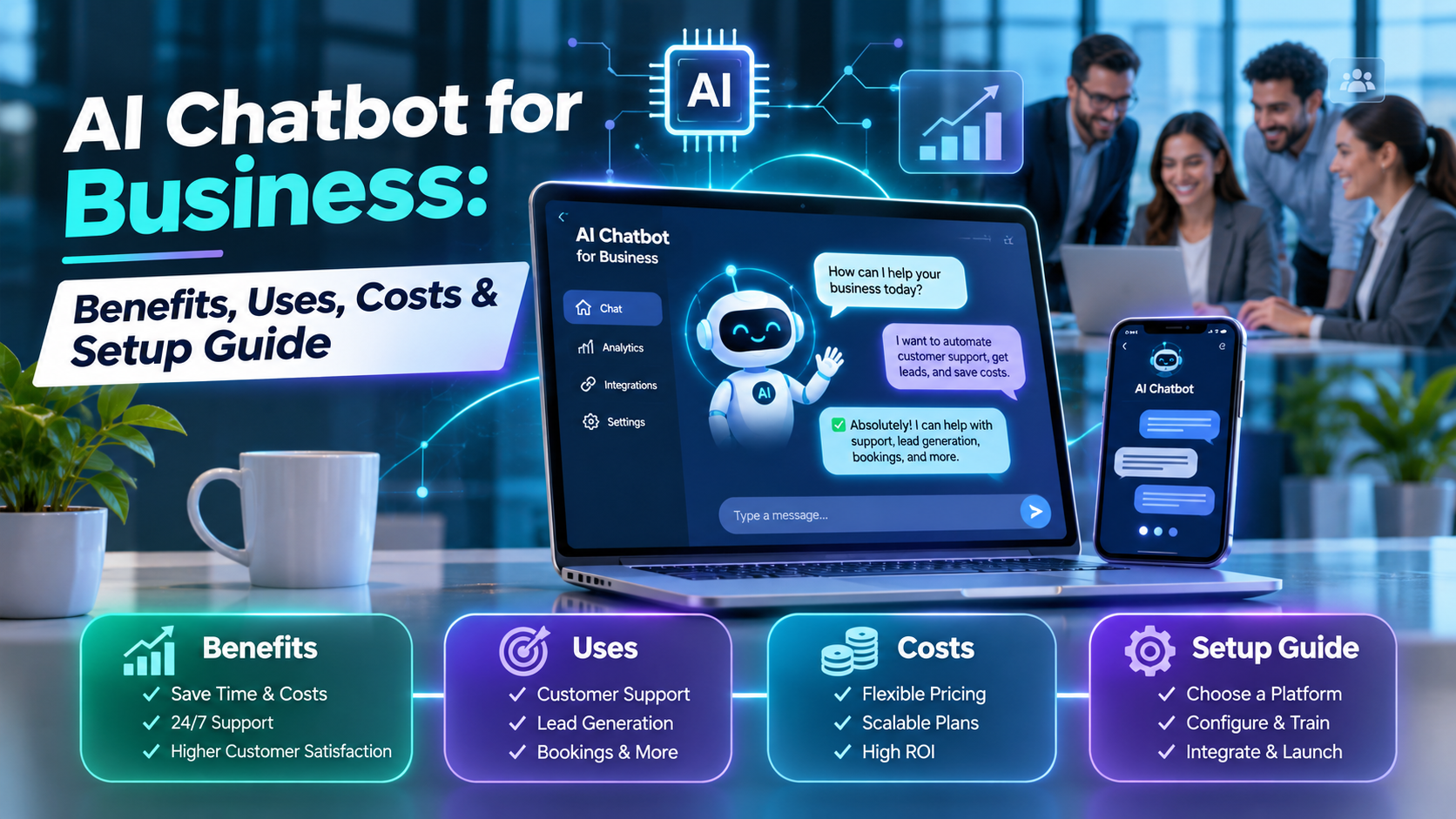
Businesses today need faster communication, better customer support, and smarter ways to generate leads. An AI chatbot helps achieve these goals by answering customer questions, automating everyday conversations, and assisting visitors throughout their buying journey.
Whether you manage a small business, an ecommerce store, or a growing enterprise, AI-powered chatbots can improve customer engagement without requiring your team to handle every conversation manually.
This guide explains what AI chatbots are, how they work, their business benefits, development costs, and the steps needed to integrate one into your website.
What Is an AI Chatbot?
An AI chatbot is a software application that uses artificial intelligence to communicate with people through text or voice. Unlike traditional chatbots that rely on fixed responses, AI-powered systems can interpret questions, understand conversational context, and generate relevant answers.
Modern conversational AI chatbots use technologies such as natural language processing (NLP), machine learning, and large language models (LLMs). These technologies help businesses automate interactions while offering customers a more flexible and personalized experience.
For example, a customer visiting an online store might ask, "Can I get this product delivered tomorrow?" An integrated chatbot can check the available delivery information and respond accordingly.
According to IBM's explanation of chatbots, modern AI systems can combine language understanding, information retrieval, and generative AI to support natural conversations.
How Does an AI Chatbot Work?
An AI chatbot processes a customer's message, identifies what they need, and prepares an appropriate response. Advanced systems can connect with business databases, websites, and customer relationship management (CRM) software to provide more accurate information.

The process generally involves:
-
User input: A visitor submits a question through a website or messaging platform.
-
Language understanding: The system interprets the question using NLP or an LLM.
-
Information retrieval: The chatbot searches approved business information or connected systems.
-
Response generation: It prepares an appropriate answer using the available context.
-
Automation: If authorized, it performs actions such as collecting lead information or creating support requests.
-
Human assistance: Complex questions can be transferred to a customer service representative.
This makes AI chatbot software useful for handling repetitive inquiries while allowing employees to focus on conversations that need human attention.
AI Chatbot vs Traditional Chatbot: What's the Difference?
Understanding traditional chatbots vs AI-powered chatbots is important when selecting automation software for your business.
|
Feature |
Traditional Chatbot |
AI Chatbot |
|
Technology |
Rules and predefined scripts |
NLP, machine learning, and AI models |
|
Conversations |
Fixed responses |
More flexible conversations |
|
Customer questions |
Handles expected questions |
Interprets varied questions |
|
Personalization |
Limited |
Can use customer context |
|
Learning and improvement |
Requires manual rule updates |
Can improve through evaluated updates |
|
Setup complexity |
Usually simpler |
Depends on integrations and requirements |
|
Best use |
Basic FAQs and menus |
Customer support, sales, and complex inquiries |
Traditional chatbots remain useful for straightforward tasks. However, businesses managing different customer questions may benefit from conversational AI solutions that can adapt to different situations.
Key Benefits of AI Chatbots for Businesses
An AI chatbot for business can improve operational efficiency, customer communication, and lead management. Its effectiveness depends on the quality of the implementation, available business data, and customer requirements.
1. Provide 24/7 Customer Support
Customers may visit your website outside normal working hours. An AI chatbot for customer service can answer common questions about products, operating hours, delivery policies, and return procedures whenever customers need assistance.
This improves accessibility and reduces the number of routine inquiries waiting for your support team.
2. Reduce Repetitive Support Work
Customer support employees frequently answer similar questions. AI customer support tools can automate these interactions and help employees concentrate on more complicated cases.
A well-configured AI support assistant can also collect relevant details before transferring a conversation to a human representative.
3. Improve Lead Generation
An AI chatbot for lead generation can engage website visitors, ask relevant questions, and collect contact information with appropriate consent.
For example, a digital marketing agency can use a chatbot to ask visitors about their project requirements, estimated budgets, and preferred services before forwarding qualified leads to its sales team. This can support a broader B2B marketing and lead generation strategy.
4. Increase Sales Opportunities
An AI sales chatbot can help customers discover suitable products, understand service packages, and navigate the purchasing process.
Instead of browsing several pages, customers can ask questions and receive recommendations based on available product information. This may reduce purchasing friction and create additional sales opportunities, complementing website conversion rate optimization.
5. Improve Customer Engagement
An AI chatbot for customer engagement provides an interactive alternative to traditional website forms.
Visitors can ask questions, compare options, and receive assistance without switching between multiple pages. Businesses can also use these conversations to identify common customer concerns and improve their website content.
6. Support Multiple Languages
A multilingual AI chatbot can communicate in different supported languages, helping businesses serve customers across locations.
However, companies should test language accuracy carefully, particularly for technical information, customer complaints, and region-specific policies.
Practical AI Chatbot Use Cases Across Industries
AI chatbot solutions are not limited to large technology companies. Businesses across different industries can use conversational automation to support everyday operations.
AI Chatbot for Ecommerce
An AI chatbot for ecommerce can assist customers throughout the shopping journey. It can work alongside ecommerce SEO in Dubai to support visitors who discover an online store through organic search.
Common applications include:
-
Product discovery and recommendations
-
Order tracking and delivery updates
-
Return and refund policy explanations
-
Product availability questions
-
Shopping cart assistance
-
Customer feedback collection
When connected to live inventory and order systems, an ecommerce chatbot can provide more useful answers than one relying entirely on static website content.
AI Chatbot for Small Business
An AI chatbot for small business operations can handle inquiries without requiring a large customer support team.
Restaurants, salons, local service providers, and consulting businesses can use chatbots to answer FAQs, collect appointment requests, share service information, and direct customers to the right employees.
AI Chatbot for Marketing
An AI chatbot for marketing can support campaign interactions and improve lead qualification.
For example, visitors arriving through an advertising campaign managed with PPC services can receive answers about specific services and pricing. Relevant leads can then be transferred into a CRM system for follow-up.
AI Chatbot for Enterprise Operations
An enterprise AI chatbot can support larger organizations with employee assistance, IT help desks, internal knowledge searches, and customer service automation.
Enterprise implementations often require advanced security, role-based access, audit logs, system integrations, and structured approval processes.
What Types of AI Chatbots Are Available?
Different chatbot technologies serve different business requirements.
Conversational AI Chatbot
A conversational AI chatbot focuses on understanding natural language and maintaining context across messages. It is commonly used in customer service, website assistance, and virtual support applications.
Generative AI Chatbot
A generative AI chatbot creates responses using trained language models and relevant context rather than selecting only predefined messages.
A GPT chatbot or LLM chatbot can explain information, summarize content, and respond to complex questions. However, businesses need safeguards because generative systems can occasionally produce incorrect answers.
AI-Powered Virtual Assistant
An AI-powered virtual assistant for business can support tasks beyond answering questions. Depending on its permissions and integrations, it may help arrange appointments, retrieve customer information, or initiate approved workflows.
Business Automation Chatbot
A business automation chatbot connects conversations with operational tasks.
For example, it may create a support ticket, update a lead record, or send an appointment confirmation after receiving valid customer information.
Best AI Chatbot Tools and Platforms for Businesses
Choosing an AI chatbot platform for websites depends on the features, budget, and level of customization required.
Some commonly considered technologies include:
|
AI chatbot tool or platform |
Typical business application |
|
OpenAI API |
Custom GPT-powered chatbot development |
|
Google Cloud Conversational Agents |
Customer service and conversational workflows |
|
Microsoft Copilot Studio |
Business assistants and workflow integrations |
|
Dialogflow |
Conversational applications and structured interactions |
|
No-code AI chatbot builder |
Basic website chatbots and lead collection |
Businesses exploring a free AI chatbot should check usage restrictions, branding requirements, integration support, and data handling policies.
Google Bard AI chatbot is also a frequently searched term. However, Google officially renamed Bard to Gemini in February 2024, as explained in Google's announcement.
When evaluating AI chatbot tools, prioritize features that genuinely solve your business problems rather than choosing a platform solely because it offers advanced AI capabilities.
How Much Does an AI Chatbot for a Website Cost?
The AI chatbot for website cost varies depending on chatbot complexity, conversation volume, AI models, integrations, customization, and ongoing maintenance.

Businesses generally choose between a subscription-based chatbot platform and a custom development project.
AI Chatbot Pricing Models
|
Pricing model |
What it includes |
Suitable for |
|
Free or trial plan |
Basic features with usage limits |
Testing and basic FAQs |
|
Monthly subscription |
Hosted chatbot software and selected integrations |
Small businesses |
|
Usage-based pricing |
Charges based on requests, messages, sessions, or tokens |
Growing applications |
|
Custom development |
Tailored chatbot, integrations, and deployment |
Businesses with specific workflows |
|
Enterprise contract |
Advanced security, support, and large-scale deployment |
Large organizations |
These are pricing structures, not fixed price quotations. Actual fees vary by provider and product.
For example, OpenAI API pricing includes token-based billing for supported models, while Google Cloud Conversational Agents pricing describes different usage-based charging methods.
Factors That Affect Chatbot Development Cost
The total cost generally depends on:
-
Number of monthly conversations
-
AI model and API usage
-
Website and CRM integrations
-
Supported languages and communication channels
-
Custom interface and chatbot design
-
Security and compliance requirements
-
Testing, hosting, monitoring, and maintenance
A basic FAQ chatbot is usually less complex than an enterprise application connected to payment systems, private databases, and multiple business platforms.
AI Chatbot Development: Step-by-Step Setup Guide
Successful AI chatbot implementation begins with understanding business requirements rather than immediately selecting software.
Step 1: Identify Your Business Goals
Decide what the chatbot should accomplish.
Your objective may be reducing repetitive customer questions, improving lead generation, supporting ecommerce orders, or providing faster website assistance.
Start with one measurable business problem before expanding into additional workflows.
Step 2: Choose the Right AI Chatbot Software
Compare available platforms based on ease of use, integration capabilities, language support, security, customization options, and pricing.
A no-code AI chatbot builder may suit straightforward requirements, while custom AI chatbot development may be more suitable for complicated business processes.
Step 3: Prepare Your Business Knowledge
Collect accurate information about products, services, pricing, policies, and frequently asked questions.
This information forms the foundation for reliable chatbot responses. Outdated or incomplete business data can create incorrect answers and damage customer confidence.
Step 4: Configure Conversation Workflows
Define how the chatbot should greet visitors, answer common questions, collect information, and transfer conversations to employees.
Include clear instructions for situations where the chatbot cannot provide a reliable answer.
Step 5: Complete Website Chatbot Integration
Website chatbot integration typically involves adding a chatbot widget, connecting approved APIs, and configuring the required business systems. Professional website development services may help when the integration requires custom engineering.
Depending on your requirements, AI chatbot integration may also include CRM platforms, ecommerce software, appointment systems, or customer support tools.
Step 6: Test Before Launching
Test the chatbot using realistic customer questions, unclear messages, spelling errors, and unexpected requests.
Check whether the system provides accurate information, protects customer data, and correctly transfers difficult conversations to human employees.
Step 7: Monitor and Improve Performance
After launch, review chatbot conversations, unresolved queries, customer feedback, and lead quality.
Regular evaluations help identify missing information and opportunities to improve chatbot accuracy, conversation flows, and customer experience.
How to Choose an AI Chatbot Development Company
If your business needs a customized solution, selecting the right AI chatbot development company is an important decision.
An experienced provider should understand your operational requirements and explain how the proposed system will work with your existing software.
Before choosing AI chatbot services, ask about:
-
Experience with similar chatbot projects
-
Supported AI models and technology
-
Data privacy and security practices
-
Website and third-party integration capabilities
-
Maintenance and ongoing support
-
Testing methods and performance reporting
-
Complete development and operating costs
The best AI chatbot solutions should be practical, secure, manageable, and aligned with measurable business objectives.
Common Challenges of AI Chatbot Automation
Although AI chatbot automation can improve business operations, companies should understand its limitations.
Incorrect responses: AI systems may generate inaccurate information when business knowledge is missing or instructions are unclear.
Privacy concerns: Customer conversations may contain personal information that requires appropriate access controls and data handling.
Integration difficulties: Connecting chatbots to older systems may require additional development.
Customer frustration: Visitors may become dissatisfied when they cannot reach a human representative.
The NIST AI Risk Management Framework provides guidance for organizations developing and using AI systems responsibly.
Businesses should combine automation with testing, human oversight, and clear escalation procedures.
How to Measure AI Chatbot Performance
Installing a chatbot is only the beginning. Businesses should measure whether it is improving customer experience and achieving operational goals.
Useful performance indicators include:
-
Resolution rate: Percentage of conversations successfully resolved.
-
Human handoff rate: Percentage requiring employee assistance.
-
Lead conversion rate: Percentage of chatbot leads becoming customers.
-
Customer satisfaction: Feedback received after chatbot interactions.
-
Response time: Time taken to provide a useful initial answer.
-
Cost per resolved conversation: Operating cost divided by successfully resolved interactions.
These metrics help businesses identify areas where chatbot automation delivers value and where improvements are needed.
Frequently Asked Questions About AI Chatbots
1. What is an AI chatbot used for?
An AI chatbot is used to automate customer conversations, answer frequently asked questions, qualify leads, recommend products, and assist with business workflows. Its capabilities depend on its configuration and connected systems.
2. Is a free AI chatbot suitable for small businesses?
A free AI chatbot can be useful for testing basic customer support and lead collection. However, free plans may limit conversations, features, integrations, or customization. Growing businesses should evaluate long-term requirements before choosing a platform.
3. Can an AI chatbot generate leads?
Yes. An AI chatbot for lead generation can ask qualifying questions, collect contact details with consent, and transfer relevant information to sales teams. Lead quality depends on the questions, targeting, and follow-up process.
4. How much does AI chatbot development cost?
AI chatbot development costs depend on complexity, integrations, conversation volume, and maintenance requirements. Basic subscription tools may require minimal setup, while custom enterprise chatbot projects can involve substantial development and operating expenses.
5. Can AI chatbots replace customer service teams?
AI chatbots can automate repetitive support tasks, but they cannot reliably handle every customer situation. Complex complaints, sensitive requests, and unusual problems may still require human judgment and assistance.
6. What is the difference between a GPT chatbot and a traditional chatbot?
A GPT chatbot uses a generative language model to interpret questions and produce flexible responses. A traditional chatbot usually follows predefined rules or scripted conversation paths.
7. How long does AI chatbot implementation take?
Implementation time depends on the project. A simple website chatbot may require relatively little configuration, while custom integrations, security reviews, and enterprise testing can extend the development process.
Conclusion: Is an AI Chatbot Worth It for Your Business?
An AI chatbot can help businesses improve customer support, automate repetitive conversations, generate leads, and create more convenient website experiences.
From small business websites to enterprise customer service systems, AI chatbot solutions offer practical opportunities to improve how organizations communicate with their customers.
However, successful implementation requires accurate business information, appropriate software, reliable integrations, and ongoing performance monitoring.
Whether you choose a ready-made platform or invest in custom AI chatbot development, start with clear business goals and build a solution that supports both your customers and your team.
Ready to improve your customer experience? Explore professional AI chatbot development and integration services to build a solution tailored to your business requirements.