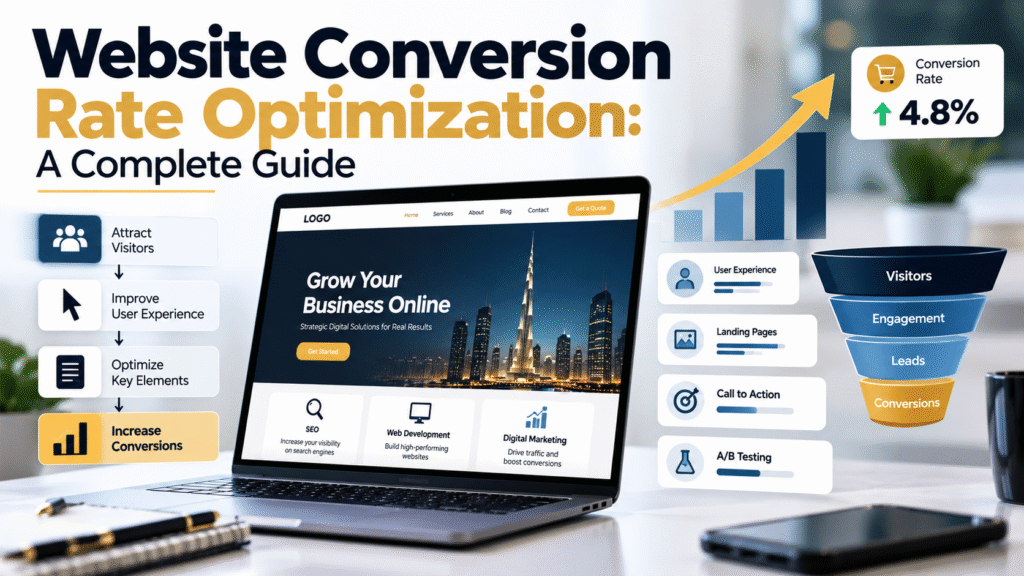
Attracting visitors to your website is important, but traffic alone does not guarantee business growth. What matters is how many visitors become customers or qualified leads. Your conversion rate measures this success and helps you understand whether your website effectively encourages visitors to take meaningful actions.
Website conversion rate optimization focuses on improving user experience, removing obstacles, and encouraging visitors to complete purchases, submit inquiries, or book services. Whether you operate an eCommerce store or a service-based business, understanding conversion optimization can help you generate more leads, increase sales, and improve overall website performance.
In this guide, we explain how conversion optimization works, its benefits, and proven strategies to improve website conversions.
What Is Website Conversion Rate Optimization?
Website conversion rate optimization (CRO) is the process of improving a website to increase the percentage of visitors who complete desired actions. These actions may include purchasing products, submitting contact forms, booking appointments, or subscribing to newsletters.
Rather than focusing entirely on attracting additional website traffic, CRO helps businesses achieve better results from their existing audience. It involves analyzing user behavior, improving website usability, and testing changes that make the customer journey easier.
For businesses looking to increase their online visibility, combining CRO with professional SEO services in Dubai can help attract relevant traffic while improving opportunities to convert visitors into customers.
How to Calculate Conversion Rate
The conversion rate formula measures how effectively your website turns visitors into customers or leads.
Conversion Rate = (Total Conversions ÷ Total Visitors) × 100
For example, if your website receives 5,000 visitors and 150 complete a purchase:
Conversion Rate = (150 ÷ 5,000) × 100 = 3%
This means 3% of visitors completed the desired action. Consistent conversion tracking helps businesses monitor performance and identify areas for improvement. Use the same measurement basis, such as users or sessions, when comparing results.
Why Is Conversion Rate Optimization Important?
A website may receive thousands of monthly visitors but generate very few inquiries or purchases. This indicates that attracting traffic alone is insufficient. Conversion optimization helps businesses understand where visitors encounter problems and how to create better digital experiences.
Key Conversion Rate Optimization Benefits
- Increased leads and sales: Encourage visitors to complete purchases, inquiries, or registrations.
- Better marketing ROI: Generate more value from existing organic and paid traffic.
- Improved user experience: Make website navigation and interactions easier.
- Lower acquisition costs: Potentially reduce customer acquisition costs through better conversion efficiency.
- Better customer insights: Understand user behavior, preferences, and expectations.
- Improved website performance: Identify usability and technical issues affecting conversions.
These conversion rate optimization benefits make CRO valuable for businesses seeking sustainable growth without continuously increasing marketing expenses.
What Is a Good Website Conversion Rate?
A good conversion rate depends on your industry, audience, website type, product pricing, and marketing channels. There is no universal benchmark that guarantees success for every business.
For example, a free newsletter registration may achieve a different conversion rate from a high-value product purchase. Businesses should establish their own performance benchmarks and monitor improvements over time.
| Website Type | Primary Conversion Goal |
| eCommerce website | Product purchases |
| Service website | Contact form submissions |
| SaaS website | Trial or demo registrations |
| Landing page | Sign-ups or inquiries |
| Educational website | Course enrollments |
Instead of focusing on an arbitrary percentage, compare current performance with historical results and business objectives.
10 Effective Strategies to Improve Website Conversion Rate
Improving website conversions requires understanding your audience and identifying the problems preventing them from taking action. The following strategies can help optimize your website and deliver a better customer experience.
1. Improve Website Speed and Performance
Website performance affects how visitors interact with your pages. Slow-loading websites can frustrate users and discourage them from exploring products or services.
According to Google’s Core Web Vitals documentation, good website performance includes three important thresholds:
- Largest Contentful Paint (LCP): 2.5 seconds or less.
- Interaction to Next Paint (INP): 200 milliseconds or less.
- Cumulative Layout Shift (CLS): 0.1 or less.
Ways to improve website speed:
- Compress images and use optimized formats.
- Remove unnecessary scripts and plugins.
- Enable browser caching.
- Improve hosting performance.
- Reduce excessive redirects.
- Test pages using Google PageSpeed Insights.
A comprehensive SEO audit can also help identify technical issues affecting loading speed, usability, and organic visibility.
2. Focus on Landing Page Optimization
Landing page optimization improves pages designed to encourage specific actions, such as booking consultations or generating inquiries. Effective landing page design clearly explains your offer and guides visitors toward the next step.
A successful landing page combines relevant messaging, compelling visuals, and a strong call to action.
Landing page optimization best practices:
- Write clear, benefit-focused headlines.
- Explain your product or service value.
- Include relevant visuals.
- Display a noticeable CTA.
- Add genuine customer testimonials.
- Remove unnecessary distractions.
- Ensure mobile responsiveness.
Businesses can also benefit from professional website development services that focus on responsive layouts, usability, and high-performing website experiences.
3. Create Clear and Engaging Calls to Action
A call to action (CTA) encourages visitors to complete a specific activity. Weak or confusing CTAs may prevent users from understanding what to do next.
Effective CTAs use straightforward, action-oriented language that reflects customer expectations.
Examples of effective CTA text:
- Get a Free Consultation
- Request a Quote
- Book an Appointment
- Explore Our Services
- Start Your Free Trial
Place CTA buttons where visitors can easily find them. The surrounding content should explain the benefits of taking action and reduce uncertainty.
4. Improve Website Usability and Navigation
Website usability determines how easily visitors can find information and interact with your content. Complicated menus, confusing layouts, and broken links create friction that may reduce website engagement.
An intuitive website allows users to navigate naturally through the customer journey.
Improve website usability by:
- Creating simple navigation menus.
- Organizing content using descriptive headings.
- Making buttons and links easy to identify.
- Optimizing layouts for mobile devices.
- Displaying clear contact information.
- Maintaining consistent design elements.
For businesses targeting smartphone users, following responsive website development best practices can help improve accessibility, navigation, and overall usability.
5. Use A/B Testing to Improve Conversions
A/B testing compares two versions of a webpage or element to determine which performs better against a specific objective.
Businesses can test landing page headlines, CTA buttons, product images, page layouts, and contact forms to understand which changes improve their conversion rate.
For example, consider two CTA variations:
Version A: Contact Us
Version B: Get Your Free Quote
A controlled test can help determine which version generates more qualified inquiries.
However, businesses should collect sufficient data before making decisions. Testing helps reduce guesswork and encourages evidence-based website improvements.
6. Simplify Forms for Better Lead Generation
Contact forms play an important role in lead generation, particularly for service-based businesses. However, long or complicated forms can discourage visitors from submitting inquiries.
Form optimization focuses on collecting essential information while reducing unnecessary effort.
Effective form optimization techniques:
- Request only necessary information.
- Use descriptive field labels.
- Avoid excessive mandatory questions.
- Provide helpful validation messages.
- Make forms mobile-friendly.
- Display confirmation messages after submission.
For example, a consultation form may initially require only a name, email address, and brief description of the customer’s requirements.
7. Optimize the Checkout Process
Checkout optimization is essential for eCommerce businesses. Customers may abandon their purchases when checkout processes are confusing, lengthy, or include unexpected charges.
Research from the Baymard Institute reports an average online shopping cart abandonment rate of approximately 70.19%, highlighting the importance of addressing checkout friction.
Checkout optimization best practices:
- Offer guest checkout where appropriate.
- Display delivery charges clearly.
- Provide suitable payment methods.
- Reduce unnecessary checkout steps.
- Make order summaries easy to review.
- Explain delivery and return policies.
Businesses can also explore eCommerce SEO strategies in Dubai to improve product visibility, attract relevant shoppers, and support online sales.
8. Analyze User Behavior With Google Analytics
Understanding user behavior is essential for identifying website conversion problems. Website analytics reveals how visitors discover your website, which pages they explore, and where they stop interacting.
Google Analytics 4 allows businesses to track website interactions and designate important actions as key events.
Important website analytics metrics include:
| Metric | Purpose |
| Conversion rate | Measures completed desired actions |
| Website traffic | Tracks users and sessions |
| Bounce rate | Identifies sessions that were not engaged |
| Engagement rate | Measures engaged sessions |
| Landing page performance | Evaluates visitor entry pages |
| Key events | Tracks important business actions |
According to Google Analytics Help, an engaged session lasts longer than 10 seconds, includes a key event, or has at least two page or screen views.
Regular analytics reviews help businesses understand website engagement and identify opportunities for improvement.
9. Optimize Your Conversion Funnel
A conversion funnel represents the stages visitors move through before completing a desired action. Understanding this process helps businesses identify where potential customers lose interest.
A typical conversion funnel includes:
- Awareness: Visitors discover your website.
- Interest: Users explore products or services.
- Consideration: Customers compare available solutions.
- Action: Visitors complete purchases or inquiries.
- Retention: Customers return for additional purchases or services.
Each stage requires relevant content and clear guidance.
For instance, potential customers comparing services may need transparent pricing, detailed information, and genuine customer reviews before making a decision.
10. Build Customer Trust Through Social Proof
Customers are more likely to engage with businesses they consider reliable and credible. Trust signals help visitors evaluate your products, services, and reputation.
Ways to build website credibility include:
- Display genuine customer reviews.
- Share verified testimonials.
- Publish relevant case studies.
- Provide accurate product information.
- Highlight clear business contact details.
- Explain refund, privacy, and delivery policies.
- Use secure website connections.
Avoid exaggerated promises and fabricated reviews. Authentic information helps customers make informed purchasing decisions and can reduce uncertainty during the sales funnel.
How to Track Website Conversions Effectively
Conversion tracking helps businesses measure whether website improvements are producing meaningful results. Without accurate tracking, determining which marketing activities contribute to sales or inquiries becomes difficult.
Basic steps to set up conversion tracking:
- Create a Google Analytics 4 property.
- Install the Google tag correctly.
- Identify important website actions.
- Configure events for those actions.
- Mark relevant events as key events.
- Verify that tracking works correctly.
- Review results across devices and traffic sources.
Businesses should also understand where visitors originate. Codevlopp’s guide on how to check, track, and increase website traffic explains traffic sources, measurement tools, and techniques for attracting relevant visitors.
How Do SEO and CRO Work Together?
Search engine optimization and conversion rate optimization support different stages of online business growth.
SEO helps attract relevant visitors through organic search, while CRO encourages those visitors to complete meaningful actions.
| SEO | CRO |
| Improves organic visibility | Improves conversion performance |
| Targets search keywords | Optimizes user actions |
| Attracts relevant traffic | Encourages leads and purchases |
| Focuses on search intent | Focuses on customer experience |
| Measures search performance | Measures conversion outcomes |
For example, SEO can help a service page attract visitors searching for a particular solution. CRO then helps those visitors understand the offer and submit an inquiry.
Google’s official page experience guidance explains that its ranking systems consider multiple aspects of page experience. However, good usability and Core Web Vitals scores alone do not guarantee top search rankings.
Combining SEO with CRO creates a balanced strategy for attracting qualified visitors and improving conversion opportunities.
When Should You Hire Conversion Rate Optimization Services?
Professional conversion rate optimization services can help businesses identify conversion barriers, analyze customer behavior, and develop structured improvement strategies.
Businesses may benefit from CRO support when they experience:
- High website traffic but low sales.
- Frequent form or checkout abandonment.
- Poor landing page performance.
- Low website engagement.
- Difficulty tracking customer actions.
- Unclear conversion funnels.
Typical conversion rate optimization services include website audits, user experience analysis, conversion tracking, landing page improvements, and A/B testing.
Businesses investing in paid marketing should also consider how CRO supports advertising performance. Professional PPC services in Dubai can attract targeted visitors, while conversion optimization focuses on improving the experience after users reach the website.
Frequently Asked Questions
What is conversion rate optimization?
Conversion rate optimization is the process of improving website elements to increase the percentage of visitors who complete desired actions, such as purchases, inquiries, or registrations.
How can I improve my website conversion rate?
Improve loading speed, optimize landing pages, create clearer CTAs, simplify contact forms, and enhance website usability. Use analytics and A/B testing to identify effective improvements.
What are the main conversion rate optimization benefits?
CRO can help increase leads and sales, improve marketing efficiency, enhance customer experience, and generate more value from existing website traffic.
Can Google Analytics track conversion rates?
Yes. Google Analytics 4 supports event tracking and key events, allowing businesses to measure important customer actions and evaluate website performance.
Does increasing website traffic guarantee better conversions?
No. More website traffic can generate additional conversion opportunities, but results depend on traffic quality, website usability, customer intent, and the effectiveness of your conversion strategy.
Conclusion
Website conversion rate optimization helps businesses turn more visitors into customers by improving website performance, landing pages, user experience, and the overall customer journey.
By combining conversion tracking, Google Analytics, A/B testing, and customer-focused improvements, businesses can identify opportunities to increase leads and sales without relying entirely on additional traffic.
Ready to improve your website conversion rate? Start by reviewing your most important pages, identifying conversion barriers, and implementing measurable improvements that make it easier for visitors to become customers.