An SEO audit is a complete check of your website to identify problems that may affect rankings, organic traffic, crawling, indexing and user experience. It can uncover technical errors, weak content, poor internal linking, slow pages and other issues that may prevent a website from performing effectively in Google Search.
Whether you use a free SEO audit, an SEO audit tool or professional services from an SEO agency in Dubai, the objective should be the same: identify the most important problems, prioritize them correctly and create a practical plan for organic growth.
What Is SEO Audit?
If you are wondering what is SEO audit, it is the process of analyzing how effectively search engines can crawl, index, understand and potentially rank the pages of your website.
Google explains that Search generally works through three stages: crawling, indexing and serving search results. Therefore, an SEO audit should verify whether important pages can successfully move through these stages. Read Google’s How Google Search Works documentation for technical details.
A complete SEO audit normally checks:
- Technical SEO
- On-page SEO
- Content quality
- Website speed
- Mobile usability
- Internal linking
- Backlinks
- Structured data
- Local SEO
- Search performance
A good audit should not simply produce hundreds of warnings. It should identify which issues can materially affect important pages and explain what should be fixed first.
Why Is an SEO Audit Important?
A website can look professional while still having serious SEO problems.
Important pages may not be indexed, several pages may compete for the same search intent, internal links may be broken, outdated content may remain indexed or important landing pages may perform poorly on mobile devices.
An SEO audit helps you:
- Find crawling and indexing problems
- Improve titles, headings and metadata
- Detect duplicate or weak content
- Fix broken links
- Improve website performance
- Strengthen internal linking
- Find ranking opportunities
- Improve local search visibility
- Monitor organic performance
Regular website audits help businesses make SEO decisions using actual search and website data instead of assumptions.
SEO Audit Checklist
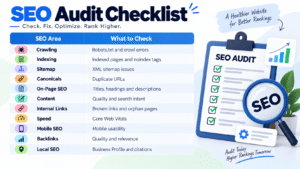
| SEO Area | What to Check |
| Crawling | Robots.txt and crawl accessibility |
| Indexing | Indexed pages and no index tags |
| Sitemap | XML sitemap configuration |
| Canonicals | Duplicate and canonical URLs |
| On-Page SEO | Titles, headings and descriptions |
| Content | Quality, relevance and search intent |
| Internal Links | Broken links and orphan pages |
| Speed | Core Web Vitals |
| Mobile SEO | Mobile usability |
| Backlinks | Quality and relevance |
| Local SEO | Google Business Profile and citations |
1. Check Crawling and Indexing
The first step in an SEO audit is determining whether Google can discover and index your important pages.
Review:
- Robots.txt
- No index directives
- XML sitemap
- Canonical tags
- Redirects
- HTTP status codes
- Crawl errors
- Indexed URLs
Google states that submitting an XML sitemap helps search engines discover URLs, although sitemap submission does not guarantee indexing. Google also limits an individual sitemap file to 50 MB uncompressed or 50,000 URLs, after which sitemap indexes or multiple sitemap files should be used. See Google’s XML sitemap guidelines.
Technical problems affecting large sections of a website may require support from a professional website development company in Dubai, particularly when problems involve templates, JavaScript rendering, redirects or website architecture.
2. Review On-Page SEO
An on-page website SEO audit checks whether individual pages clearly communicate their purpose to visitors and search engines.
Review:
- SEO title
- Meta description
- H1
- H2 and H3 headings
- URL structure
- Primary keyword
- Supporting keywords
- Image alt text
- Internal links
- Search intent
Use the primary keyword naturally in important areas such as the title, H1, introduction and relevant headings.
Avoid forcing keywords into every paragraph.
Google does not specify a fixed character limit for the HTML title element. Instead, title links may be truncated depending on the device and available display width. Google recommends descriptive, distinct titles and specifically advises against keyword stuffing. Review Google’s title link best practices.
3. Audit Your Website Content
Content should satisfy the reason behind the search.
During an SEO audit, look for:
- Thin content
- Duplicate content
- Outdated information
- Weak introductions
- Poor readability
- Missing information
- Keyword stuffing
- Multiple pages targeting the same search intent
- Pages receiving impressions but few clicks
For websites with large numbers of old or overlapping pages, a structured Content Pruning SEO strategy can help determine whether pages should be improved, consolidated, redirected, no indexed or removed rather than deleting pages simply because they receive little traffic.
Search intent is particularly important.
Someone searching for free SEO audit online probably wants a quick tool or website check. A person searching for SEO audit services Dubai is more likely comparing agencies or professional services.
Your page must satisfy the intent behind its target keywords rather than simply containing those keywords.
When weak or outdated copy is a major problem, professional content writing services in Dubai can help improve informational depth, search intent coverage and readability.
4. Check Internal Linking
Internal links help users discover related information and help search engines understand connections between pages.
Check for:
- Broken internal links
- Orphan pages
- Weak anchor text
- Important pages receiving very few links
- Excessive links from irrelevant pages
- Pages buried too deeply in the site architecture
Google recommends using crawlable <a> links with descriptive, concise anchor text and says that pages you care about should normally be linked from at least one other page on your website. Read Google’s SEO link best practices.
Internal linking should therefore be based on context.
For example, a complete SEO guide can naturally link to resources about technical SEO, local SEO, content optimization, website performance and SEO hacks when those pages provide additional information relevant to the section.
Do not add internal links simply to increase the number of links on a page.
5. Check Page Speed and Core Web Vitals
Website performance should be included in every complete SEO audit.
The current Core Web Vitals focus on three user-experience areas:
| Metric | Good Threshold |
| LCP | 2.5 seconds or less |
| INP | 200 milliseconds or less |
| CLS | 0.1 or less |
Google’s web.dev guidance recommends assessing these targets at the 75th percentile of page loads, separately across mobile and desktop where appropriate. Review the official Core Web Vitals guidance.
Common performance improvements include:
- Compressing large images
- Reducing unnecessary JavaScript
- Improving server response
- Removing unused CSS
- Using effective lazy loading
- Preventing unexpected layout shifts
- Optimizing fonts and media
Businesses struggling with mobile performance can also review responsive website development services in Dubai to understand how responsive architecture, mobile usability and performance connect.
Google currently uses the mobile version of a site’s content for indexing and ranking under mobile-first indexing. This makes it important that important content, metadata and structured data remain available on mobile pages. See Google’s mobile-first indexing best practices.
6. Review Backlinks
Backlinks remain useful signals, but link relevance and quality matter more than simply collecting large numbers of referring pages.
During a backlink audit, review:
- Referring domains
- Relevant backlinks
- Lost backlinks
- Anchor text
- Spammy links
- Pages receiving the most links
- Links pointing to redirected or deleted pages
Search Console’s Links report can help examine external and internal links, but Google notes that the report is a sample rather than a comprehensive list of every link pointing to your website. See the official Search Console Links report documentation.
Avoid buying bulk backlinks, automated links or participating in link schemes designed primarily to manipulate rankings. Google’s current Search spam policies explicitly address manipulative link practices and other ranking manipulation techniques.
7. Check Structured Data
Structured data can provide search engines with additional machine-readable information about page content.
Depending on the website, relevant schema types may include:
- Organization
- LocalBusiness
- Product
- Article
- Breadcrumb
- Event
- Video
Structured data should accurately represent content that users can see on the page.
Google states that valid structured data can make a page eligible for applicable rich results, but implementing valid markup does not guarantee that a rich result will actually appear. Review Google’s structured data guidelines.
Validate important markup before deployment and monitor structured-data issues after publication.
8. SEO Audit for Dubai Businesses
A local SEO audit Dubai strategy requires additional checks for businesses targeting customers in Dubai and the wider UAE.
Review:
- Google Business Profile
- Business name, address and phone information
- Opening hours
- Primary and secondary business categories
- Customer reviews
- Local landing pages
- Dubai-focused keywords
- Local citations
- Locally relevant backlinks
- Mobile user experience
Businesses that depend on nearby customers should understand the fundamentals of local SEO for small businesses when auditing their local search presence.
Google explains that local results are primarily determined through relevance, distance and prominence. Complete Business Profile information, reviews and links can contribute to Google’s understanding of a local business. Read Google’s official local ranking guidance.
Best SEO Audit Tools
There is no single best SEO audit tool for every website.
Different tools answer different questions.
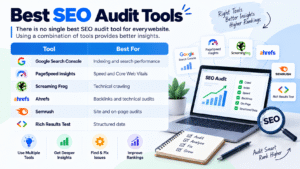
| Tool | Best For |
| Google Search Console | Search performance and indexing |
| PageSpeed Insights | Website performance |
| Screaming Frog | Technical crawling |
| Ahrefs | Backlinks and competitor research |
| Semrush | Site and on-page audits |
| Rich Results Test | Structured data |
For a free SEO audit, Google Search Console and PageSpeed Insights provide useful starting points.
A good SEO website audit tool can automatically identify common problems, while an SEO audit report generator can organize findings.
However, automated tools cannot fully determine business importance, search intent or which problem should receive the highest priority.
Free SEO Audit vs Professional SEO Audit
| Free SEO Audit | Professional SEO Audit |
| Basic checks | Detailed analysis |
| Mostly automated | Expert review |
| General recommendations | Customized strategy |
| Useful for small websites | Better for complex or competitive sites |
A free SEO audit online is useful for finding basic technical or on-page problems.
Professional audits can go deeper into technical SEO, keyword strategy, content, competitors, backlinks, local visibility and conversion-focused landing pages.
Businesses comparing professional services should also understand the factors behind SEO cost in Dubai instead of choosing an agency purely on the lowest monthly price.
How to Prioritize SEO Issues
Not every SEO warning deserves the same level of attention.
A practical priority order is:
- Critical: blocked pages, indexing failures, server errors and major migration problems
- High: important content gaps, broken revenue-page links and severe performance problems
- Medium: metadata, internal-link improvements and structured-data issues
- Low: minor formatting or low-impact warnings
Always prioritize issues affecting important service, product, category or lead-generation pages.
SEO Audit Ranking Tips
Match Search Intent
Understand why someone is searching for a particular keyword.
For example: best SEO audit tool usually has informational or comparison intent.
SEO audit services in Dubai normally has stronger commercial intent.
The page type and content should reflect that difference.
Improve Existing Pages
Pages already receiving relevant impressions can sometimes offer stronger optimization opportunities than publishing another page targeting the same topic.
Improve them with:
- More useful headings
- Updated information
- Stronger internal links
- Better intent matching
- Improved titles
- Missing subtopics
- Clearer CTAs
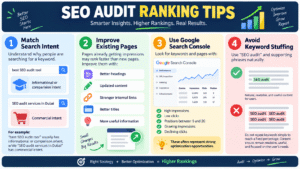
Use Google Search Console
Use Search Console to identify queries and pages with meaningful visibility and examine:
- Impressions
- Clicks
- CTR
- Search queries
- Landing pages
- Changes over time
Google specifically recommends focusing on trends in impressions and clicks rather than relying on average position alone. Its Performance report also allows you to identify popular queries and pages with significant changes. See Google’s Search Console Performance report guide.
Relevant queries with high impressions but weak engagement may reveal opportunities to improve headings, search intent coverage or title messaging.
Avoid Keyword Stuffing
Use SEO audit and supporting terms naturally.
Do not repeat keywords simply to achieve a predetermined density percentage.
Google recommends using the words people use to search in useful locations such as titles, headings, alt text and link text, while maintaining helpful, people-focused content.
Consider AI Search Visibility
Modern audits may also examine whether important brand and service information can be understood and discovered by AI-powered search experiences.
An AI visibility audit can complement traditional SEO analysis by reviewing crawl accessibility, content gaps, brand information, citations and third-party authority.
Businesses developing a broader search strategy can additionally explore generative engine optimization in Dubai as part of long-term visibility planning.
Frequently Asked Questions
1. What is an SEO audit?
An SEO audit is a detailed review of a website’s technical SEO, content, links, performance, indexing and search visibility. It identifies problems and opportunities that may influence organic performance.
2. Can I do a free SEO audit online?
Yes. A basic free SEO audit can be completed using tools such as Google Search Console, PageSpeed Insights and structured-data validation tools.
3. What is the best SEO audit tool?
The best SEO audit tool depends on what you need to investigate. Search Console is valuable for Google search performance and indexing, Screaming Frog for technical crawling, and tools such as Ahrefs or Semrush can provide broader backlink, keyword and competitor insights.
4. How often should I perform an SEO audit?
A detailed website SEO audit can generally be performed periodically according to the size and rate of change of the website. Additional audits are particularly useful after migrations, redesigns, significant traffic changes or major technical updates.
5. What does an SEO audit report include?
A professional SEO audit report normally covers crawling, indexing, on-page SEO, content, internal links, website performance, mobile usability, structured data, backlinks and ranking opportunities.
6. Why should Dubai businesses get an SEO audit?
An SEO audit can reveal both technical and local SEO problems affecting Dubai businesses. It can also uncover opportunities involving Google Business Profile, location-focused search intent, reviews, citations, local landing pages and Dubai-related keywords.
Conclusion
A professional SEO audit helps you understand what may be limiting your website’s organic search performance.
Start with crawling and indexing, then review on-page SEO, content quality, internal links, Core Web Vitals, mobile usability, structured data, backlinks and local search visibility.
You can begin with a free SEO audit using Google’s tools or invest in professional SEO audit services in Dubai for deeper technical, competitive and strategic analysis.
Most importantly, an SEO audit should produce an actionable plan—not simply a long list of errors.
Fix critical problems first, strengthen pages that already show search potential, build contextual internal links and continue monitoring performance as the website evolves.