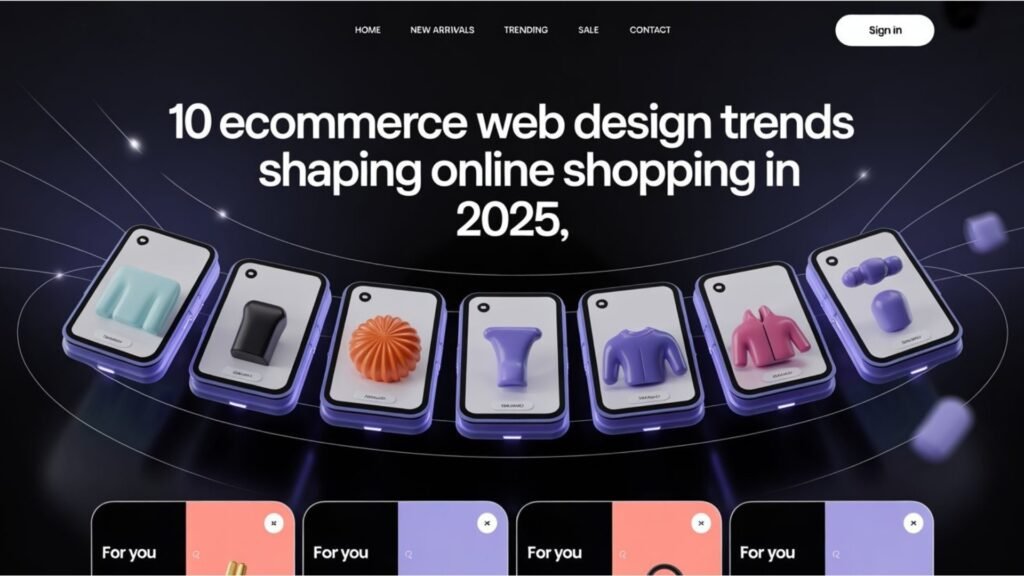
10 Ecommerce Web Design Trends Shaping Online Shopping in 2026
Online stores are entering a new stage where design is expected to do much more than look attractive. The most important ecommerce web design trends in 2026 focus on helping shoppers discover products faster, understand them better, build trust, and complete purchases with less effort across mobile and desktop devices.
Businesses that followed ecommerce website design trends 2025 already moved toward faster pages, cleaner layouts, stronger product visuals, and mobile-first shopping. In 2026, these ideas are becoming more intelligent. AI, immersive product viewing, adaptive interfaces, accessibility, and frictionless checkout are shaping how modern ecommerce experiences are designed.
Building these experiences also requires more than attractive layouts. A professional website development company in Dubai can connect visual design with responsive development, ecommerce functionality, navigation, performance, payment integrations, and scalable technical architecture.
How Ecommerce Design Is Changing from 2024 to 2026
The biggest difference between ecommerce website design trends 2024, ecommerce design trends 2025, and 2026 is the move from static presentation toward responsive and intelligent shopping experiences. An ecommerce website is no longer simply a digital catalogue; it increasingly acts like a shopping assistant that reacts to user intent and behaviour.
| Period | Main Design Focus | What Shoppers Expect |
| 2024 | Clean layouts, mobile responsiveness, strong visuals | Easy browsing and dependable mobile shopping |
| 2025 | Faster pages, personalization, richer product content | Relevant recommendations and lower friction |
| 2026 | AI assistance, adaptive UX, AR/3D, accessibility, seamless checkout | Faster decisions, confidence, convenience and trust |
This evolution explains why many 2025 ecommerce design trends remain relevant while their execution continues to change. The strongest ecommerce design trends 2026 combine visual design, UX, data, automation, technical performance, and conversion optimization instead of treating them as completely separate areas of ecommerce development.
1. AI-Powered Personalization Becomes Part of the Interface
One of the biggest ecommerce web design trends in 2026 is AI-powered personalization. Instead of displaying the same homepage, categories, product recommendations, and offers to every visitor, ecommerce stores can increasingly adapt their experience according to browsing behaviour, purchase history, cart activity, saved preferences, and real-time shopping intent.
According to Shopify’s 2026 AI trends research, 75% of surveyed store owners reported using AI tools for areas such as content generation, data analysis, and store operations. This adoption is helping AI move beyond back-office automation and become part of customer-facing ecommerce experiences.
Useful personalization can include:
- Recommended products based on recent browsing.
- Personalized product collections.
- Returning-customer shortcuts.
- Complementary product suggestions.
- Personalized bundles and promotions.
- Search results based on shopper intent.
- Recently viewed product reminders.
However, personalization should simplify shopping rather than make the website unpredictable. Businesses working with an e-commerce marketing agency in Dubai can connect personalization with conversion optimization, product-page improvements, abandoned-cart strategies, customer retention, and other full-funnel ecommerce activities.
2. Conversational Search and AI Shopping Assistants Grow
Traditional ecommerce search relies heavily on exact keywords, filters, and category structures. In 2026, conversational search is becoming more visible among ecommerce web design trends because shoppers increasingly expect to describe what they need naturally rather than correctly guessing a store’s product terminology.
For example, instead of choosing several filters, a shopper could search for “a lightweight black jacket for rainy travel.” An AI-powered ecommerce assistant may interpret the requirements, find suitable products, explain differences, answer questions, compare options, and help the shopper move closer to a buying decision.
Useful conversational design elements include:
- Natural-language search boxes.
- Suggested shopping prompts.
- AI-powered product recommendations.
- Product cards within search responses.
- Conversational product comparisons.
- Easy access to standard filters.
- Clear explanations of recommendations.
The rise of AI-powered shopping is also connected with changes in how consumers discover businesses through search engines and generative platforms. Brands preparing for that wider shift can also explore Generative Engine Optimization in Dubai to understand how website structure, content, authority, and technical accessibility affect visibility in AI-powered search.
This is one area where modern e-commerce design trends 2025 are developing rapidly. Chat interfaces were previously treated mainly as customer-support tools. In 2026, they are becoming more closely connected with product discovery, comparison, recommendations, and purchasing decisions.
3. Mobile-First Design Becomes More Task-Focused
Mobile-first design is not new, but the 2026 version focuses more heavily on completing shopping tasks with fewer taps. Among all ecommerce web design trends, this remains essential because consumers increasingly browse collections, compare products, read reviews, save items, contact brands, and purchase directly from smartphones.
Google announced that after July 5, 2024, websites used for Search would be crawled and indexed with Googlebot Smartphone, with limited desktop crawling still used for some specific search features. The Google mobile-first indexing update reinforces why mobile accessibility should remain a fundamental website requirement.
A mobile ecommerce store should not simply feel like a smaller version of a desktop website. It should prioritize thumb-friendly interactions, readable information, quick filters, compact menus, clear purchase actions, efficient checkout forms, and product media that loads quickly.
Important mobile improvements include:
- Sticky “Add to Cart” buttons.
- Simple bottom navigation.
- Large touch-friendly controls.
- Short filter and sorting flows.
- Fast image galleries.
- Mobile-friendly forms.
- Digital wallet options.
- Reduced intrusive pop-ups.
For deeper implementation guidance, Codevlopp’s guide to mobile-first UI design best practices explains principles such as touch optimization, consistent interfaces, visual hierarchy, accessibility, whitespace, performance, and intuitive mobile navigation.
For modern web design trends for retail clothing stores, these mobile details are particularly important because customers often compare colours, sizes, fit information, lifestyle photos, reviews, return conditions, and delivery information before placing an order.
4. 3D Product Views and Augmented Reality Become More Practical
Flat product photography remains important, but interactive product presentation is becoming one of the most useful ecommerce web design trends for products where size, texture, dimensions, finish, configuration, or appearance can be difficult to understand through conventional product images alone.
According to Shopify’s 2026 guide to 3D ecommerce, fashion brand Rebecca Minkoff found that shoppers interacting with a 3D product model were 44% more likely to add the product to their cart. Shoppers who viewed products using AR were 65% more likely to purchase. These are brand-specific case-study results rather than universal ecommerce benchmarks.
Practical applications include:
- 360-degree product rotation.
- Zoomable 3D models.
- Virtual fashion try-on.
- Virtual beauty previews.
- “View in your room” furniture features.
- Product configuration tools.
- Colour and material visualization.
- Size and scale demonstrations.
These experiences are especially relevant to modern web design trends for retail clothing stores, where product appearance strongly influences purchasing decisions. Fashion businesses can also support their ecommerce strategy through a specialized fashion marketing agency in Dubai focused on fashion SEO, product-page optimization, visual storytelling, paid campaigns, and conversion-focused landing pages.
In 2026, immersive ecommerce design works best when it solves a genuine buying problem. Adding 3D simply because it looks impressive can increase development and performance requirements without necessarily improving the shopping experience.
5. Performance-First Visual Design Replaces Heavy Effects
One of the most important ecommerce web design trends is actually restraint. Large background videos, unnecessary animations, oversized JavaScript libraries, third-party widgets, and heavy product galleries may appear impressive but can slow down the browsing and shopping experience significantly.
Google’s Core Web Vitals guidance recommends aiming for a Largest Contentful Paint of 2.5 seconds or less, Interaction to Next Paint below 200 milliseconds, and Cumulative Layout Shift below 0.1 to provide a good user experience.
Design and development teams can improve performance by:
- Compressing product images.
- Serving correctly sized images.
- Using modern image formats.
- Lazy-loading below-the-fold media.
- Reducing unnecessary scripts.
- Limiting autoplay videos.
- Reserving image dimensions.
- Optimizing fonts.
- Testing actual mobile performance.
This is where ecommerce design trends 2025 and 2026 strongly overlap. The key difference is that speed is increasingly considered during design decisions rather than being treated as something developers should repair after a visually heavy website has already been built.
Businesses struggling with mobile layouts, speed, or cross-device usability can review Codevlopp’s responsive website development services in Dubai for more information about responsive architecture, mobile-first development, page-speed optimization, cross-device testing, ecommerce development, and usability.
6. Product Pages Become More Visual, Informative and Decision-Focused
Product pages are moving beyond the traditional combination of image, title, price, and short description. One of the most practical ecommerce web design trends in 2026 is decision-focused product design, where useful information appears close to the point at which customers need it.
A strong product page can combine professional photography, product videos, specifications, reviews, delivery estimates, size information, returns policies, FAQs, related items, trust signals, and recommendations without overwhelming the shopper. The objective is to reduce uncertainty rather than add information simply to make the page longer.
Important product-page elements include:
- Clear product names.
- Visible prices.
- Important product benefits.
- Size and fit details.
- Materials and specifications.
- Delivery estimates.
- Returns information.
- Customer reviews.
- Product videos.
- Related products.
- Stock availability.
- Clear purchase buttons.
Google explains in its merchant listing structured data documentation that Product and Offer markup can help provide information such as product price, availability, shipping details, and return information for eligible Google Search experiences.
Product-page design should therefore support both customers and search engines. Codevlopp’s guide to Ecommerce SEO in Dubai also covers product-page SEO, category optimization, product information, image optimization, structured data, technical ecommerce SEO, and internal linking.
For businesses reviewing ecommerce website design trends 2025, improving product information remains one of the strongest principles to carry forward into 2026.
7. Checkout Design Becomes Shorter and More Transparent
Beautiful ecommerce design means little if customers struggle to complete their order. Checkout optimization remains one of the highest-impact ecommerce web design trends because the final stage of the buying journey can still create unnecessary friction.
According to Baymard Institute’s 2026 cart abandonment statistics, the average documented ecommerce cart-abandonment rate is 70.19%. Among surveyed US shoppers, major reasons include high additional costs, slow delivery, payment-security concerns, forced account creation, and lengthy checkout processes.
A better checkout experience should therefore include:
- Prominent guest checkout.
- Fewer unnecessary form fields.
- Address autocomplete.
- Browser autofill compatibility.
- Transparent delivery charges.
- Clear delivery estimates.
- Trusted payment methods.
- Easy error correction.
- Visible order summaries.
- Mobile-friendly keyboards.
The direction of 2025 ecommerce design trends was already toward cleaner checkout interfaces. In 2026, the focus goes further toward transparency. Customers should understand the total amount, shipping fees, delivery expectations, returns conditions, and available payment options before committing to the order.
Businesses should also test the checkout journey from a real shopper’s point of view. A visually attractive interface can still perform poorly if customers cannot understand what happens after clicking “Checkout,” cannot find guest checkout, or discover unexpected charges too late.
8. Accessibility Moves from Compliance to Everyday UX
Accessibility is becoming a stronger component of ecommerce web design trends because inclusive interfaces can improve usability for a wider range of customers. Readable typography, sufficient contrast, keyboard access, clear labels, descriptive buttons, and predictable page behaviour can benefit everyone using an ecommerce website.
The W3C Web Content Accessibility Guidelines 2.2 provide internationally recognized recommendations for making digital content more accessible to users with visual, auditory, physical, speech, cognitive, neurological, and other disabilities across desktop and mobile devices.
Important ecommerce accessibility considerations include:
- Sufficient text contrast.
- Readable font sizes.
- Visible keyboard focus.
- Alternative text for meaningful images.
- Proper form labels.
- Descriptive buttons.
- Accessible menus.
- Video captions.
- Helpful error messages.
- Adequate touch-target sizes.
Accessibility fits naturally with the cleaner and simpler direction seen in modern e-commerce design trends 2025. In 2026, accessibility should increasingly be built into user-interface decisions from the beginning rather than being treated as a technical correction after development.
Good UX also requires thoughtful visual communication. Businesses planning consistent interfaces, typography, digital graphics, and brand presentation can explore Codevlopp’s graphic design agency in Dubai services, which include UI/UX-related digital design alongside broader visual-brand work.
9. Privacy-First Personalization Builds More Trust
Customers appreciate useful recommendations, but they also want control over how websites collect and use their information. As personalization and AI become more common, privacy-aware interface design is becoming another important part of ecommerce web design trends.
The UK Information Commissioner’s Office explains in its cookies and similar technologies guidance that organizations should clearly explain relevant cookie use and, where required, obtain valid consent through a clear positive action.
Although privacy requirements depend on the markets in which a business operates, good privacy UX generally means customers should be able to understand what choices they are making without navigating confusing menus or manipulative consent interfaces.
A privacy-friendly ecommerce interface can make it easy to:
- Review cookie preferences.
- Control optional tracking.
- Change communication preferences.
- Understand personalization choices.
- Review saved addresses.
- Manage stored account information.
- Access privacy information easily.
This trend is closely linked with customer trust. As ecommerce design trends 2026 become more data-driven, stores need to balance personalization with transparency and user control.
The objective should not be to hide privacy decisions behind complicated interfaces. Clear language and understandable options can support trust while still allowing businesses to use legitimate personalization and analytics tools.
10. Modular, Clean Design Supports Faster Shopping Journeys
Another important direction among ecommerce web design trends is modular ecommerce design. Reusable content sections can be adapted for product launches, categories, seasonal campaigns, customer segments, landing pages, and multiple devices without requiring teams to redesign the entire website every time.
Visually, this approach often produces cleaner interfaces with clear typography, generous spacing, consistent product cards, predictable calls to action, and purposeful visual hierarchy. Many of these ideas appeared across ecommerce website design trends 2024 and ecommerce design trends 2025, but the 2026 approach is becoming more flexible.
A modular system can help ecommerce businesses:
- Launch landing pages faster.
- Maintain consistent branding.
- Keep buttons and product cards uniform.
- Rearrange content sections.
- Test page structures.
- Support multiple product categories.
- Maintain responsive behaviour.
- Scale designs across markets.
For modern web design trends for retail clothing stores, modular design is particularly useful because brands often need seasonal collection pages, lookbooks, product grids, size guides, styling recommendations, promotional sections, user-generated content, and campaign landing pages throughout the year.
Instead of building completely separate designs for every campaign, businesses can create reusable sections while keeping the navigation, purchase experience, and brand identity consistent.
Which Ecommerce Web Design Trends Should You Prioritize?
Not every business needs to implement every new technology immediately. The best ecommerce web design trends are those that solve genuine customer problems, reduce friction, build confidence, and shorten the journey between product discovery and purchase.
A furniture store may receive greater value from AR room visualization, while an apparel store might benefit more from advanced filtering, clear sizing information, mobile optimization, personalized recommendations, high-quality product video, and simplified returns information.
A practical order of implementation is:
- Fix mobile usability problems.
- Improve website speed.
- Improve product information.
- Simplify navigation.
- Reduce checkout friction.
- Improve accessibility.
- Add useful personalization.
- Test AI-assisted product discovery.
- Consider AR or 3D where appropriate.
- Measure results before expanding.
This prevents businesses from chasing new technology simply because it is fashionable. Advanced ecommerce website design trends should ultimately improve product discovery, buying confidence, accessibility, convenience, conversion, or customer satisfaction.
What Ecommerce Teams Should Measure in 2026
Following ecommerce web design trends only makes sense when website changes produce useful customer or business outcomes. Ecommerce teams should therefore establish baseline performance before redesigning major areas and track how individual design improvements affect user behaviour.
| Design Area | Useful Metrics |
| Homepage | Product click-through rate, navigation engagement |
| Category pages | Filter use, product clicks, exits |
| Product pages | Add-to-cart rate, video engagement, size-guide use |
| Mobile experience | Mobile conversion, Core Web Vitals |
| Checkout | Completion rate, errors, abandonment |
| Recommendations | Recommendation clicks, assisted purchases |
| AR/3D | Interaction, conversion, return rate |
| Accessibility | Audit issues, keyboard usability, form completion |
Technical measurement should also be part of ongoing optimization. Codevlopp’s Complete SEO Audit Guide covers areas such as mobile usability, Core Web Vitals, structured data, internal linking, indexing, site performance, and other website-health checks that can affect organic performance.
Measurement keeps ecommerce design trends connected with real outcomes. An advanced feature can increase website complexity without helping shoppers, while a relatively simple improvement to filters, navigation, product information, or checkout could produce much greater value.
From Ecommerce Website Design Trends 2024 to Ecommerce Design Trends 2026
Looking back at ecommerce website design trends 2024, much of the focus was placed on responsive layouts, visual simplicity, mobile optimization, typography, and better product presentation. Those foundations have not disappeared. Instead, newer technologies are being layered onto them.
The strongest 2025 ecommerce design trends expanded that foundation through faster shopping journeys, richer product content, personalized merchandising, social proof, video, and simplified checkout.
By comparison, ecommerce design trends 2026 place greater emphasis on interfaces that react intelligently to customer intent. AI shopping assistants, adaptive product discovery, immersive visualization, improved accessibility, privacy-conscious personalization, and performance-led design are becoming increasingly connected.
For teams that invested in ecommerce website design trends 2025, the lesson is not to rebuild everything. Businesses should retain what already improves speed, clarity, accessibility, product discovery, and conversion while introducing new technology only where it solves a measurable problem.
The transition from ecommerce website design trends 2024 through ecommerce design trends 2025 and into ecommerce design trends 2026 is therefore evolutionary rather than a complete reset.
Strong ecommerce UX still depends on:
- Clear navigation.
- Fast pages.
- Helpful product content.
- Mobile responsiveness.
- Accessible interfaces.
- Trustworthy information.
- Transparent pricing.
- Simple checkout.
Many 2025 ecommerce design trends remain relevant in 2026, especially mobile-first layouts, clean typography, product storytelling, personalized recommendations, visual content, performance optimization, and simplified checkout.
What is changing is the intelligence behind those interfaces. The best modern e-commerce design trends 2025 are increasingly being combined with AI, customer data, automation, improved product visualization, and more adaptive user journeys.
Frequently Asked Questions
What are the biggest ecommerce web design trends in 2026?
The biggest ecommerce web design trends include AI personalization, conversational shopping, mobile-first interfaces, 3D and AR product visualization, performance-first design, stronger product pages, simplified checkout, accessibility, privacy-conscious personalization, and modular ecommerce design systems.
Are ecommerce design trends 2025 still relevant in 2026?
Yes. Many ecommerce design trends 2025 remain highly relevant, particularly mobile responsiveness, faster pages, visual product storytelling, personalization, cleaner interfaces, and simplified checkout. In 2026, these foundations are increasingly being enhanced through AI and more adaptive shopping experiences.
How are ecommerce website design trends 2025 different from 2026 trends?
Ecommerce website design trends 2025 placed strong emphasis on mobile shopping, speed, personalization, product visuals, and clean UX. Ecommerce design trends 2026 build on them with AI shopping assistance, adaptive interfaces, practical AR and 3D applications, accessibility, privacy controls, and more intelligent product discovery.
What changed from ecommerce website design trends 2024?
Many ecommerce website design trends 2024 focused on responsive layouts, visual simplicity, typography, mobile optimization, and better product presentation. These principles remain important, but newer ecommerce experiences are becoming more interactive, personalized, intelligent, accessible, and focused on reducing the effort required to purchase.
Which modern web design trends for retail clothing stores matter most?
Useful modern web design trends for retail clothing stores include mobile-first product pages, strong product photography, virtual try-on, clear sizing and fit information, quick filters, personalized product suggestions, customer reviews, transparent returns information, visual recommendations, and streamlined mobile checkout.
Are modern e-commerce design trends 2025 outdated?
No. Many modern e-commerce design trends 2025 form the foundation of ecommerce design in 2026. Fast websites, strong mobile UX, personalized merchandising, product video, social proof, clean layouts, and simplified checkout continue to be valuable.
Should every ecommerce store use AI and AR?
No. AI and AR should address a specific customer or business need. Stores should first improve fundamentals such as speed, usability, mobile responsiveness, product information, accessibility, navigation, and checkout. Advanced technologies become useful when they clearly improve product discovery, visualization, confidence, or convenience.
Final Thoughts
The most important ecommerce web design trends shaping online shopping in 2026 are not simply about making stores look futuristic. They are about helping customers move from product discovery to purchase with less confusion, uncertainty, waiting, and unnecessary effort.
AI personalization, conversational shopping, mobile-first UX, 3D product experiences, performance-first design, stronger product pages, frictionless checkout, accessibility, privacy, and modular interfaces all support that larger goal.
The lessons from ecommerce website design trends 2025, 2025 ecommerce design trends, modern e-commerce design trends 2025, and even ecommerce website design trends 2024 remain important because good ecommerce design still starts with speed, clarity, usability, and trust.
Businesses should therefore avoid implementing every trend simply because competitors are doing it. The strongest ecommerce design trends 2026 will be the ones that solve real customer problems, communicate products clearly, increase buying confidence, and make ecommerce journeys easier across devices.